
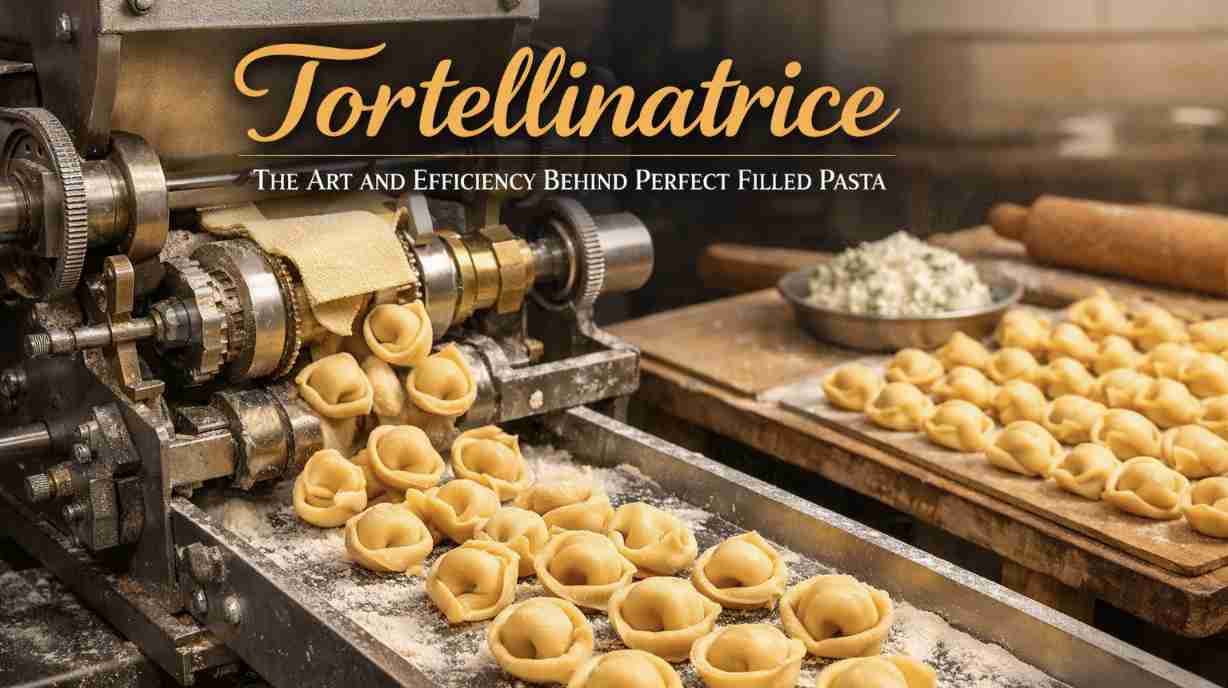
Tortellinatrice: The Art and Efficiency Behind Perfect Filled Pasta
Fresh filled pasta has always held a special place in Italian cuisine, blending tradition with craftsmanship. In today’s professional kitchens and food production labs, technology plays a major role in keeping that tradition alive while meeting modern demand. This is where the Tortellinatrice becomes an essential tool, combining precision, speed, and consistency to create high-quality tortellini and similar pasta shapes.
Understanding the Role of a Tortellinatrice in Pasta Making

At its core, this machine is designed to automate the production of filled pasta while preserving its artisanal look and taste. From small trattorias to large-scale pasta factories, professionals rely on specialized pasta equipment to deliver uniform results every time.
What makes filled pasta unique
Filled pasta such as tortellini, cappelletti, and ravioli requires careful balance. The dough must be thin but strong, while the filling needs to be evenly distributed. Achieving this manually is time-consuming and demands a high skill level.
Traditional craftsmanship meets innovation
By integrating modern engineering with traditional pasta-making principles, manufacturers can maintain authenticity while improving productivity. The use of food-grade materials and precise forming mechanisms ensures that each piece reflects the standards of Italian culinary heritage.
How the Machine Works in Professional Kitchens
Automation does not mean losing control over quality. Instead, it offers consistency that is difficult to achieve by hand, especially in busy environments.
Dough forming and filling process
The process starts with fresh pasta dough fed into rollers that flatten it to the desired thickness. The filling is then injected with accuracy, and the pasta is shaped and sealed. This controlled process reduces waste and ensures food safety.
Consistency and hygiene advantages
Uniform size and weight are essential for even cooking and professional presentation. With stainless steel components and easy-to-clean surfaces, these machines meet strict hygiene standards required in commercial food production.
Benefits of Using a Tortellinatrice for Businesses

For restaurants, bakeries, and pasta producers, efficiency can determine profitability. Investing in the right equipment often leads to long-term gains.
Using a Tortellinatrice allows businesses to significantly reduce manual labor while increasing output. Staff can focus on recipe development and quality control rather than repetitive tasks. The result is a steady supply of fresh pasta that meets customer expectations.
Beyond speed, reliability is a major advantage. Consistent production helps maintain brand identity, especially for businesses selling packaged fresh pasta. Energy-efficient motors and durable construction also mean lower operational costs over time.
Choosing the Right Machine for Your Needs
Not all pasta operations are the same, and selecting the right model depends on several factors.
Production scale and capacity
Small restaurants may need compact machines that produce limited batches, while industrial facilities require high-capacity systems capable of continuous operation. Understanding daily output goals is the first step.
Maintenance and long-term value
Ease of maintenance should never be overlooked. Machines with modular components are easier to service and clean, reducing downtime. A well-chosen Tortellinatrice can last for years, making it a smart investment rather than a simple expense.
FAQ: Common Questions About Tortellinatrice Machines
What types of pasta can be produced?
Most machines are designed for tortellini, cappelletti, and similar filled pasta, with some models offering interchangeable molds.
Is fresh pasta quality affected by automation?
When used correctly, automation maintains consistent quality and often improves uniformity compared to manual production.
Are these machines suitable for small businesses?
Yes, many manufacturers offer compact models tailored for small kitchens and artisanal producers.
How difficult is cleaning and maintenance?
Modern designs focus on easy disassembly and cleaning, helping operators meet hygiene standards efficiently.
Conclusion
The evolution of pasta-making equipment shows how tradition and technology can coexist. By streamlining production while respecting authentic recipes, modern solutions empower chefs and producers alike. Whether for a small restaurant or a large-scale facility, choosing the right Tortellinatrice can elevate efficiency, consistency, and product quality. In a competitive food industry, this balance between heritage and innovation is what keeps filled pasta timeless and loved around the world.
